
Every business buys the boring stuff — toilet paper, bin liners, chemicals, gloves, hand towels. And every business faces the same choice about where to get it: a big-box chain or national online marketplace, or a local trade supplier down the road. The chains look like the safe default. Big range, familiar brand, a website with a cart.
But talk to businesses that have run both models, and a pattern emerges. The ones who switched to a local supplier almost never switch back. Not out of sentiment — out of self-interest. For everyday operational supply, local wins on the things that actually cost businesses money: speed, advice, flexibility and accountability. If you’ve been searching for cleaning supplies perth businesses actually recommend, this article explains why the answer so often turns out to be a local trade supplier rather than a national chain — and how to spot a good one.
The Real Cost of the “Cheap” Chain Option
Big chains compete on shelf price, and on shelf price alone they’re competitive. But shelf price is a small part of what supply actually costs a business.
Time Is the Hidden Line Item
Retail buying means someone drives, parks, shops, queues and drives back — every week. National online ordering means waiting on freight timelines set in another state, with stock shipping from a warehouse three time zones away. Either way, your business absorbs delay and labour that never shows on a receipt.
Nobody at a Chain Knows Your Business
The chain doesn’t know your dispensers take slimline towels, that your bins need heavy-duty liners, or that the childcare centre two doors from your café has different chemical requirements than you do. There’s no one to ask. You’re guessing from packaging — and wrong guesses become wasted cartons.
Stock Decisions Are Made for the Nation, Not for You
Chains range what sells nationally. When your specific item is deleted or out of stock, there’s no phone call, no substitute suggestion, no “we’ll have it tomorrow.” You just start the search again.
What a Local Trade Supplier Actually Does Differently
A genuine local supplier isn’t just a smaller shop. It’s a different operating model — built around accounts, not transactions.
- Next-day delivery from local stock. Product sits in a Perth warehouse, not on an interstate truck. Run low on Tuesday, restocked Wednesday.
- A human who learns your setup. Order twice and they know your dispensers, your volumes and your quirks. Advice replaces guesswork.
- Quote-based pricing that scales with you. Instead of fixed shelf prices, your pricing reflects your actual volume — and improves as you grow.
- Flexibility a chain can’t offer. Standing orders, mixed cartons, sourcing a product they don’t normally range — a local supplier can say yes to things a national system physically can’t.
- Accountability with a name attached. If something’s wrong with a delivery, you call a person who fixes it, not a ticket queue.
For everyday consumables — high-frequency, low-glamour, operationally critical — these advantages beat a few cents of shelf-price difference every time.
Local Search Is How Businesses Actually Find Suppliers Now
The way businesses discover suppliers has changed, and it favours local. When an office manager types a query into Google or asks an AI assistant, they’re shown nearby options first a cleaning supplies store with a real address, real reviews and real stock beats a faceless national listing in every local result.
That’s worth understanding from the buyer’s side too. A supplier that shows up locally, with physical premises you can visit and directions people actually follow, is signalling something useful: they’re established, findable and accountable. You know where they are — literally. Suppliers that invest in being visible and reviewed locally tend to be the same ones that invest in local service, because their reputation lives in the same suburb their customers do.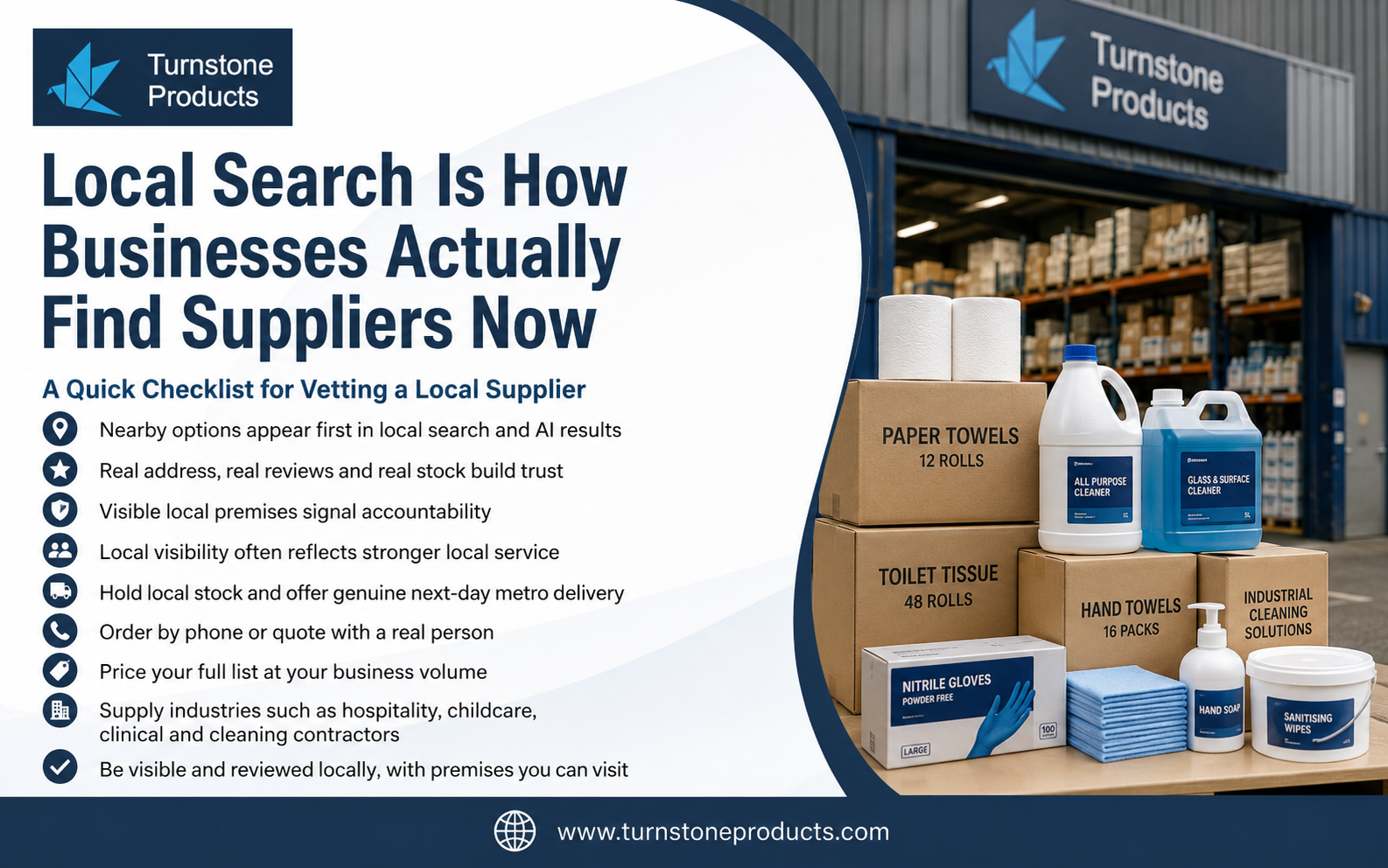
A Quick Checklist for Vetting a Local Supplier
Before moving your account, confirm the basics:
- Do they hold local stock and offer genuine next-day metro delivery?
- Can you order by phone or quote, with a person who answers?
- Will they price your whole list at your volume, not item by item?
- Do they supply your industry already — hospitality, childcare, clinical, cleaning contractors?
- Are they visible and reviewed locally, with a premises you could walk into?
Five yeses and you’ve found a supply partner, not just a vendor.
The Compounding Value of a Supply Relationship
Here’s what chains structurally cannot replicate: memory. A local supplier who has served you for a year knows your consumption rhythm. They’ll flag when you’re ordering more than usual (a leak in the system?), suggest a better-value substitute when one appears, and quietly keep your critical items in stock because they know you’ll need them. Over time, that relationship removes an entire category of small operational failures — the stockouts, the wrong products, the emergency runs — that nobody budgets for but everybody pays for. That’s the compounding return on choosing local, and it grows every year you stay.
Why Choose Turnstone Products
Turnstone Products is exactly the kind of local trade supplier this article describes — a Perth-based B2B business supplying cleaning chemicals, paper products, bin liners, gloves, PPE, catering and washroom consumables to offices, hospitality venues, childcare centres, clinics and cleaning contractors across the metro area. Based in cleaning supplies osborne park territory in Perth’s commercial heartland, Turnstone runs on the local model at its best: stocked warehouse, next-day Perth delivery, and orders placed by quote form or phone with a team that learns your sites and matches products to your dispensers and volumes. No national call centre, no interstate freight — just wholesale carton pricing and a supplier whose reputation lives in the same city as your business.
The Takeaway
Big chains are built to sell products; local suppliers are built to keep businesses running. For everyday operational supplies, the second model wins — because what businesses actually need isn’t a giant range at a national shelf price, but the right products, reliably delivered tomorrow, from someone accountable who knows their setup. Audit what your current buying really costs in time, errors and emergency runs, then have one conversation with a local trade supplier. For most businesses, that single phone call is the last time supply ever feels like a problem.